Spontaneous Localization from Cosmological Geometry
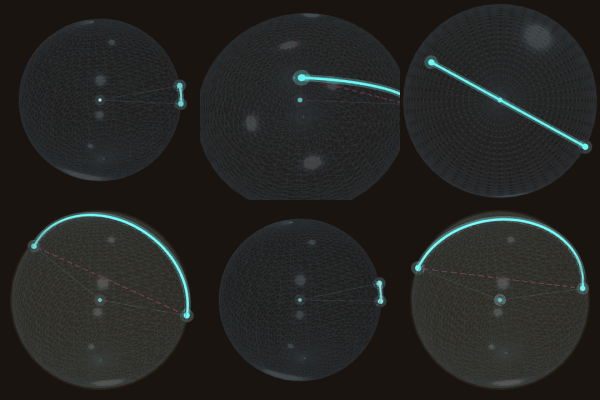 Explore the Geometry: Angular Fidelity Gap →
Section IThe Problem
Quantum mechanics is the most successful theory in the history of science. It predicts the behavior of atoms, light, and matter with extraordinary precision. But it has a hole at its center: it cannot explain how the world we experience emerges from the world it describes.
In the quantum world, particles exist in superpositionsuperpositionA quantum system existing in multiple states simultaneously until measured. Schrödinger's cat is the famous thought experiment: the cat is both alive and dead until observed. — multiple states at once. When we measure them, they “collapse” into a single definite outcome. But the theory never says why or how this collapse happens. This is the measurement problem — the deepest unsolved question in physics.
Physicists have proposed collapse models — most notably GRWGRW/CSLGhirardi-Rimini-Weber (1986) and Continuous Spontaneous Localization. The leading collapse models that add a random “hit” to the Schrödinger equation, forcing superpositions to collapse. The problem: both require hand-inserted parameters./CSL — that add a collapse mechanism to the equations. But these models have a fundamental weakness: they require free parametersfree parametersNumbers that must be inserted into a theory by hand, chosen to fit observations rather than derived from first principles. A theory with fewer free parameters is considered more fundamental. inserted by hand. The localization width (how sharply things collapse) and the collapse rate (how often) are chosen to fit observations, not derived from anything deeper.
This paper derives them from the geometry of the universe itself.
Section IIThe Architecture
The paper proposes a three-body architecturethree-body architectureThe paper's framework: three mutually constraining scales — microscopic quantum system, high-dimensional environment, and macroscopic cosmological background — that together determine the collapse kernel with no free parameters.: three scales of reality that mutually constrain each other. The local quantum subsystem (what you measure), the high-dimensional environmental manifold (everything surrounding it), and the macroscopic cosmological background (the expanding universe). None can be understood in isolation. The collapse emerges from their interaction.
The first result restores local tomographylocal tomographyThe ability to completely characterize a composite quantum system by measuring its parts separately. Standard real quantum mechanics fails this test. The paper's J-balanced quotient space restores it. in real vector spaces. Previous no-go theorems (Wootters, Hardy) showed that real quantum mechanics cannot fully describe composite systems — you need complex numbers. The paper constructs a J-balanced quotient space that bypasses these theorems, recovering all the predictive power of complex quantum mechanics using only real-valued mathematics. The Born ruleBorn ruleThe fundamental rule of quantum measurement: the probability of an outcome equals the square of the wave function's amplitude. Every quantum prediction depends on it, but standard theory never explains why probabilities are squared. — the foundational equation of quantum probability — follows as a consequence.
Section IIIThe Shadow
How does the Gaussian collapse kernelcollapse kernelThe mathematical function that governs how quantum superpositions localize into definite outcomes. In GRW/CSL models it is Gaussian (bell-shaped) but the shape is assumed, not derived. This paper derives it from geometry. — the bell-shaped function governing how superpositions become definite outcomes — arise? Existing models assume it. This paper derives it.
The environment is modeled as a high-dimensional hypersphere. A deep theorem of probability — measure concentrationmeasure concentrationA mathematical phenomenon: on high-dimensional spheres, almost all of the surface area is concentrated near the equator. Random coordinate projections converge to Gaussian distributions. This is Lévy's lemma and the Poincaré-Borel theorem. — shows that on such spheres, random projections converge to a Gaussian distribution. The paper identifies this projection with the physical act of measurement: tracing out the unobserved environment yields an exact Gaussian spatial decoherencedecoherenceThe process by which quantum superpositions lose their “quantumness” through interaction with the environment. Decoherence explains why we don't see macroscopic superpositions, but it does not by itself solve the measurement problem. functional. The collapse kernel is not assumed — it is the geometric shadow of a sphere projected onto a plane.
The shadow is Gaussian because the sphere is round.
Section IVThe Electron’s Wavelength
This is the headline result.
Collapse localizes particles in space. But localization injects energy — the tighter you squeeze something, the more it kicks (Heisenberg's uncertainty principle). Shrink the localization width and the energy injection diverges as σ−5 — catastrophically, at small scales.
But the expansion of the universe provides a counterbalance. The cosmological Ricci scalarRicci scalarA measure of spacetime curvature from general relativity. In the paper, the dimensionless Ricci scalar drives the base collapse rate: the universe's geometry determines how fast quantum systems localize. — a measure of how curved spacetime is — sets the base collapse rate. The paper balances the σ−5 ultraviolet divergence against the cosmological Ricci tension, constrained by the experimental noise floor measured by LISA Pathfinder. The balance forces a single critical scale:
Electron reduced Compton wavelengthCompton wavelengthThe quantum-mechanical scale of a particle — the wavelength at which its wave nature becomes dominant. For the electron: ~3.86 × 10⁻¹³ m. The paper derives this scale from geometry, not measurement.: 3.86 × 10⁻¹³ m
Ratio: 0.96 — agreement to 4%
Free Parameters in the Microscopic Dynamics Zero
The electron’s size is not inserted. It falls out of the thermodynamic balance between quantum localization and cosmological curvature like a coin from a pocket — as though it had been sitting there all along, waiting for someone to reach in.
Section VThe Prediction
A theory that only explains what we already know is not falsifiable. This paper makes a prediction.
When the geometric collapse mechanism is integrated into the standard equations governing how matter clusters in the expanding universe, it produces a distinctive signature: a chirped residualchirped residualA frequency-drifting deviation in the matter power spectrum. Unlike smooth tilts from dark energy models, this has a sharp onset at a specific cosmic epoch — a qualitative signature that standard cosmology cannot replicate. in the matter power spectrum — a frequency-drifting deviation from the standard ΛCDMΛCDMLambda-Cold Dark Matter: the standard model of cosmology. Describes the universe as expanding with a cosmological constant (Λ) driving acceleration and cold dark matter providing gravitational scaffolding. Fits most data but has no mechanism for quantum collapse. prediction. The onset is sharp, occurring at redshift z ≈ 24 — Cosmic Dawn, the epoch when the first stars and galaxies formed.
The paper tests this prediction against the most precise cosmological measurements available: DESIDESIDark Energy Spectroscopic Instrument. A sky survey measuring baryon acoustic oscillations (sound waves frozen into the distribution of galaxies) at 12 precision redshift bins from z = 0.295 to z = 2.33. The most precise distance measurements in cosmology. Data Release 1 baryon acoustic oscillation distances.
What this table says in plain English:
Three theories are tested against real measurements of how galaxies are spaced across the universe.
“Parameters” = how many numbers each theory has to guess. Fewer is better — it means the theory explains more on its own.
“χ²” (chi-squared) = a score for how well the theory matches the data. Lower is better.
“σ” (sigma) = how confident we are that one theory beats another. 2σ means ~95% confident. 3σ would be ~99.7%.
The standard model (ΛCDM) uses zero guessed numbers and scores 21.15.
A competing model (CPL) uses two guessed numbers and scores 11.67 — much better, but it doesn't explain why.
This paper's model uses just one number and scores 16.87 — meaningfully better than the standard, and it explains when and why the effect turns on.
| Model | ParametersparametersNumbers the theory must guess to fit the data. Zero means the theory predicts everything from first principles. More parameters = more flexibility but less explanatory power. | χ²chi-squared (χ²)A statistical score measuring how well a theory matches observations. Lower means better fit. It's calculated by comparing predicted values to measured values across all data points. | vs. ΛCDMΛCDMThe standard model of cosmology. Λ (lambda) is the cosmological constant driving the universe's accelerating expansion. CDM is cold dark matter. Together they describe the universe's large-scale behavior. |
|---|---|---|---|
| ΛCDM (Planck 2018)ΛCDM (Planck 2018)The baseline: the standard model of the universe, using measurements from the Planck satellite (2018). No adjustable numbers — everything is fixed by the satellite data. | 0 | 21.15 | — |
| CPL (w₀wa)CPL modelChevallier-Polarski-Linder: a flexible dark energy model with two free parameters (w₀ and wa) that describe how dark energy changes over time. Fits data well but doesn't explain why — purely descriptive. | 2 | 11.67 | −9.48 (2.6σ2.6 sigmaAbout 99% confident this model fits better than the standard. In physics, 3σ is “evidence” and 5σ is “discovery.” 2.6σ is suggestive but not definitive.) |
| Three-Body | 1 | 16.87 | −4.28 (2.1σ2.1 sigmaAbout 96% confident this model fits better than the standard. Not yet at the 3σ “evidence” threshold, but with only one parameter (vs. CPL's two), the efficiency is notable.) |
The Three-Body model achieves a 2.1-sigma improvement over standard cosmology with a single constrained parameter — and unlike the phenomenological CPL model, it predicts the onset redshift from theory rather than fitting it from data.
Section VIWhy It Matters
This paper offers four mutually reinforcing results:
Kinematic completeness. Real quantum mechanics is restored without complex numbers. The Born rule follows from the geometry rather than being postulated.
Geometric collapse. The Gaussian kernel is derived from measure concentration on a high-dimensional sphere — not assumed. The collapse is the shadow.
Thermodynamic viability. The electron Compton wavelength emerges from the balance between quantum localization and cosmological curvature with zero free parameters in the microscopic dynamics.
Falsifiable cosmology. A chirped residual with Cosmic Dawn onset provides a qualitative signature distinguishable from ΛCDM and testable with next-generation surveys.
The measurement problem is not a problem about measurements. It is a problem about the relationship between the observer and the geometry of the universe the observer inhabits.
If this framework is correct, then the collapse of the quantum wave function is not a mysterious interruption of physics. It is physics — the geometric inevitability of a sphere casting shadows onto a plane. The electron’s wavelength is not a brute fact of nature. It is the thermodynamic signature of the universe holding itself together.
The paper will stand or fall on its mathematics, and the mathematics is available for review.
Brian Christopher Nyberg, M.D.
Cedar City, Utah
April 2026
This summary was composed in collaboration with Claude (Anthropic, Opus 4.6). The full paper contains complete mathematical derivations, proofs, and computational verification. All code is available at github.com/docnyberg/three-body-architecture.
Part of the Sovereign Publication Suite